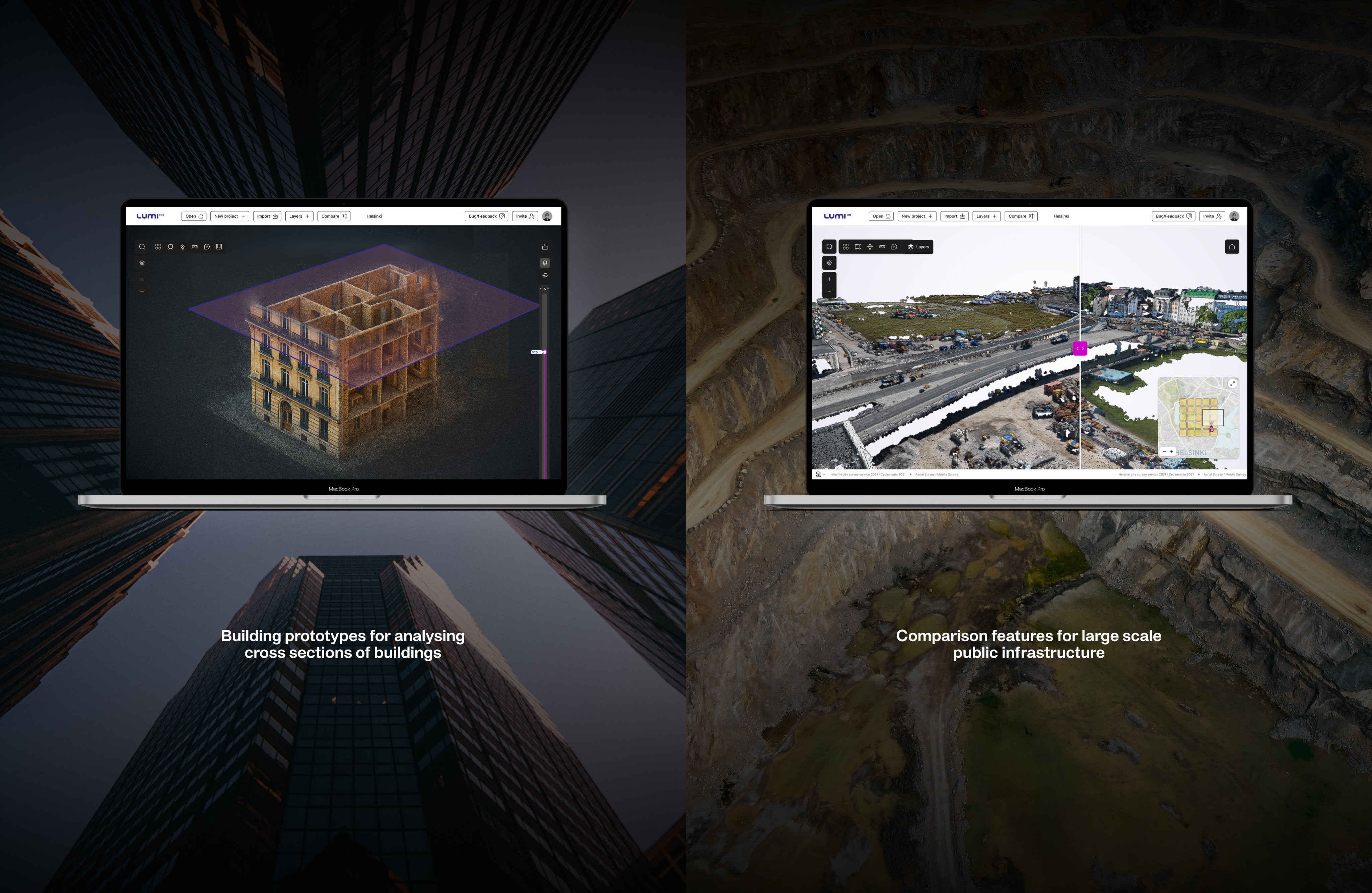
LumiDB: The 3D Point Cloud Database — Turning chaos into single source of truth
LumiDB is building a point cloud database for organizations working with reality capture data. Instead of moving massive files between folders and stakeholders, LumiDB makes point clouds searchable, shareable, and usable as a single system — all in the cloud.
Nordkapp partnered with LumiDB to design a credible, implementation-ready product experience at startup speed. The goal was simple: move fast, validate every step, and help LumiDB earn customers without burning runway. The database engine already worked — our job was to turn it into a product: user-centred, validated in real use cases, and ready to ship as an MVP.
Physical infrastructure owners and constructors face an uncontrolled, exponential growth in the amount of point cloud data. Point clouds are typically generated by capturing 3D measurements from the real world using LiDAR, depth/stereo cameras, photogrammetry, or by sampling points from synthetic 3D models/simulations. Massive files, often 20–50 GB each, accumulate in disconnected network drives and outdated portals.
Because this data is siloed and unindexed, locating a specific dataset takes days of emails and manual searching. Once found, the files are too heavy for standard software, requiring expensive specialists to manually crop and prepare data for reuse. LumiDB's technology replaces this fragmented, file-based workflow with a unified, cloud-native database that makes petabyte-scale archives instantly accessible.
Super efficient project model — tailor made for producing quick Time-to-Market results for a startup company.
6 weeks from onboarding to delivery — including UI concepts, user validation, and a design system built for implementation.
Starting Point
LumiDB had a strong product and a clear promise: all point clouds in one place. But as an early-stage company, they needed speed without waste—design decisions that hold up in the market, not just in meetings.
The challenge wasn’t aesthetics. It was clarity and credibility. LumiDB had to introduce a new category—a point cloud database—in a way that feels obvious, trustworthy, and easy to adopt.
Our task was to turn deep tech into a product people can use immediately: a design that sells in a demo, supports real workflows, and can be implemented fast enough to match startup momentum.
AI was used to speed up the project. AI was used for UI innovation, brand innovation, content creation, 3D generation, making working UI's with "vibe coding" and so on.
Strategy / Insight
We designed for speed, but refused to rely on assumptions.
Instead of a long design phase followed by a big delivery, we worked in short cycles: prototype, test, refine. The process stayed lightweight, but every key decision was validated with real potential customers.
The insight that guided the work was straightforward: point cloud workflows break down when teams can’t answer basic questions quickly — what’s the latest scan, where is it from, and who can access it. The best design solution isn’t “more features.” It’s making the data reliable, findable, and easy to share.
Creative Solution
We approached LumiDB with one perspective:
Treat point clouds like modern data, not heavy files.
That single decision shaped everything. The experience needed to behave like a database: searchable, structured, collaborative, and scalable. We focused the narrative on outcomes instead of technical complexity — helping users understand the value in minutes, not after a deep explanation.
To keep the design both fast and accurate, we used prototyping as the main design tool. We continuously tested real flows with real users, which made iteration faster and the final product far more confident.
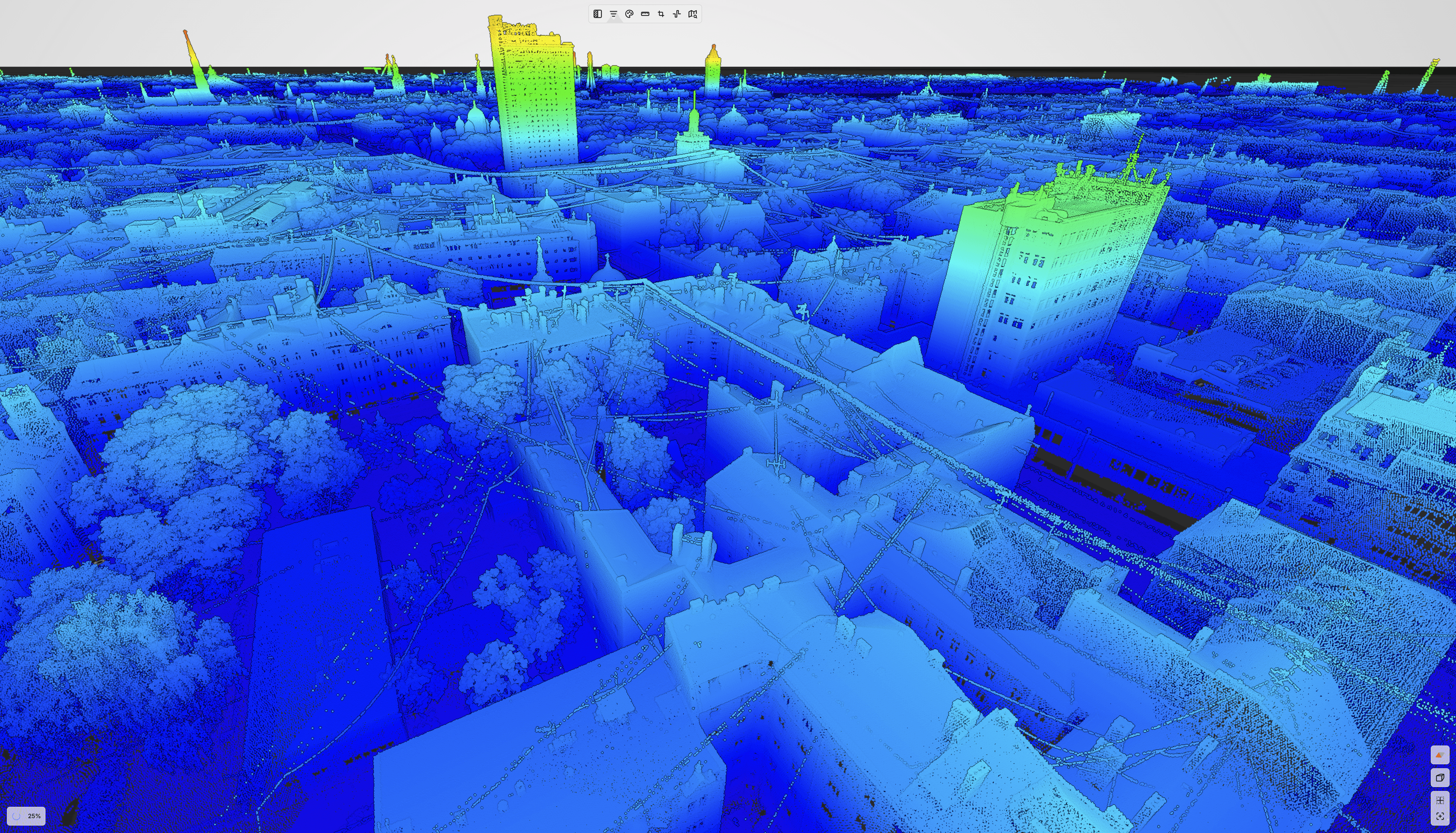
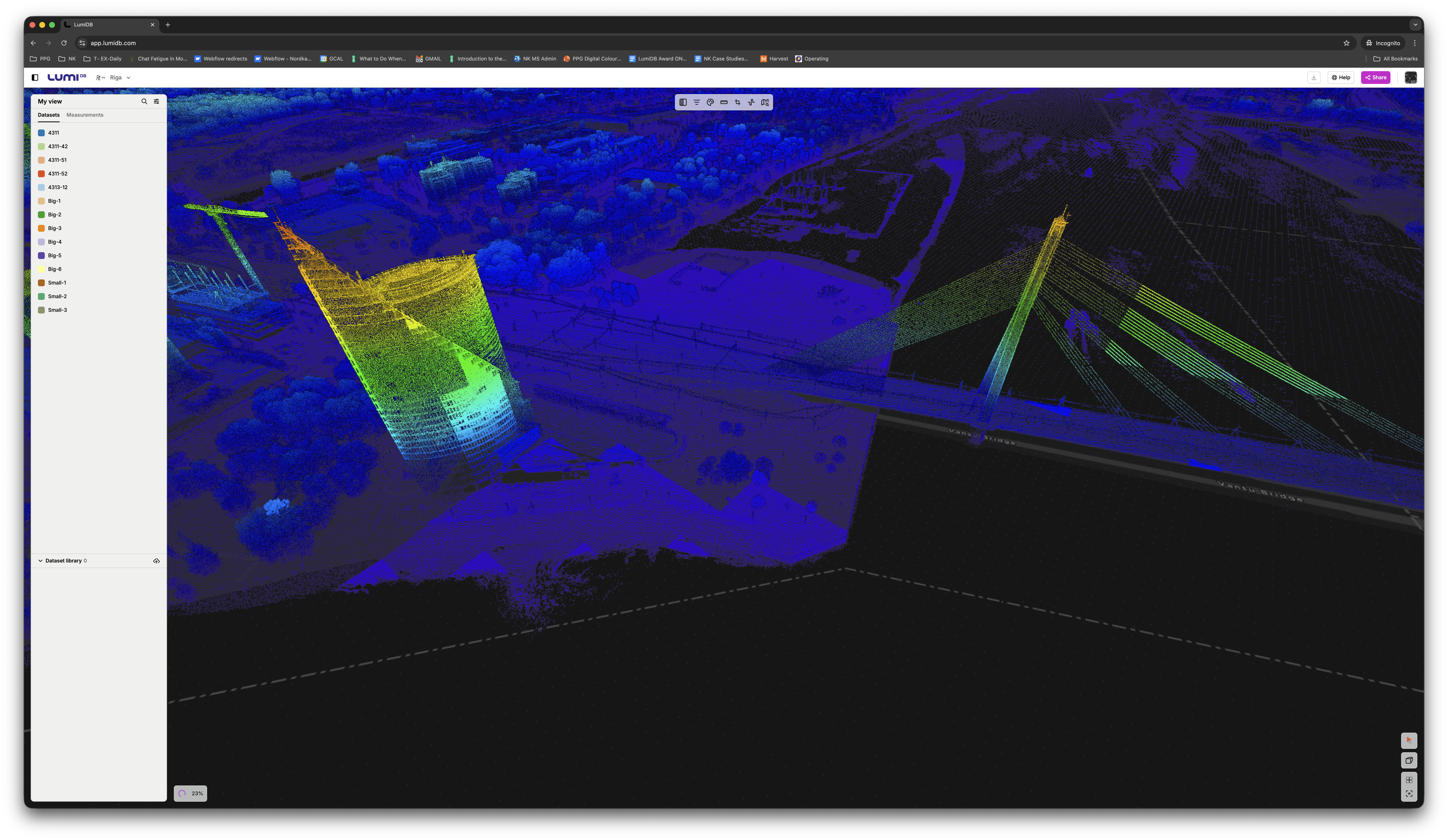
Point-cloud view of a Helsinki street where LumiDB streams mobile-scan data for façades and aerial-scan data for roofs in a single visualization. Read more at City of Helsinki Case Study.
Implementation
The implementation brings LumiDB’s promise to life with an experience built around how reality capture data is actually used.
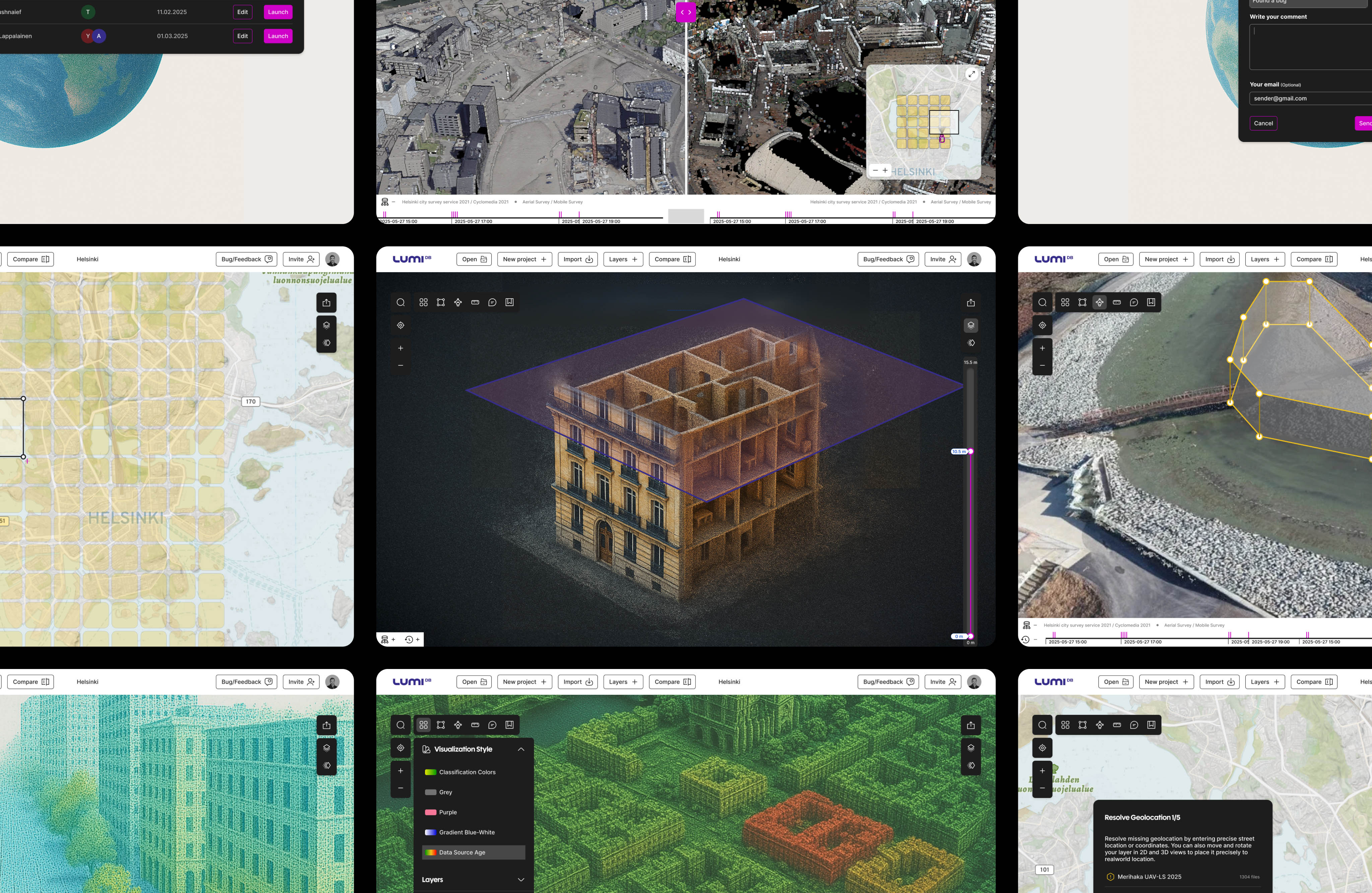
Search and discoverability are driven by the two dimensions that matter most: where and when. Location and time are not secondary metadata — they define how teams find and trust point cloud data. The experience supports map-based exploration, time-based indexing, and filtered views that make large datasets practical to navigate.
To support real-world collaboration, the product enables sharing through links and controlled access. Instead of sending files, teams can share the right view of the data, with permission and scope clearly defined.
Beyond the UI, LumiDB comes with an API, an on-demand export function, and abilities to stream data into other applications using standard exchange formats. This ensures the design is not a "walled garden" but a backbone that feeds data directly into CAD, GIS, and digital twin applications.
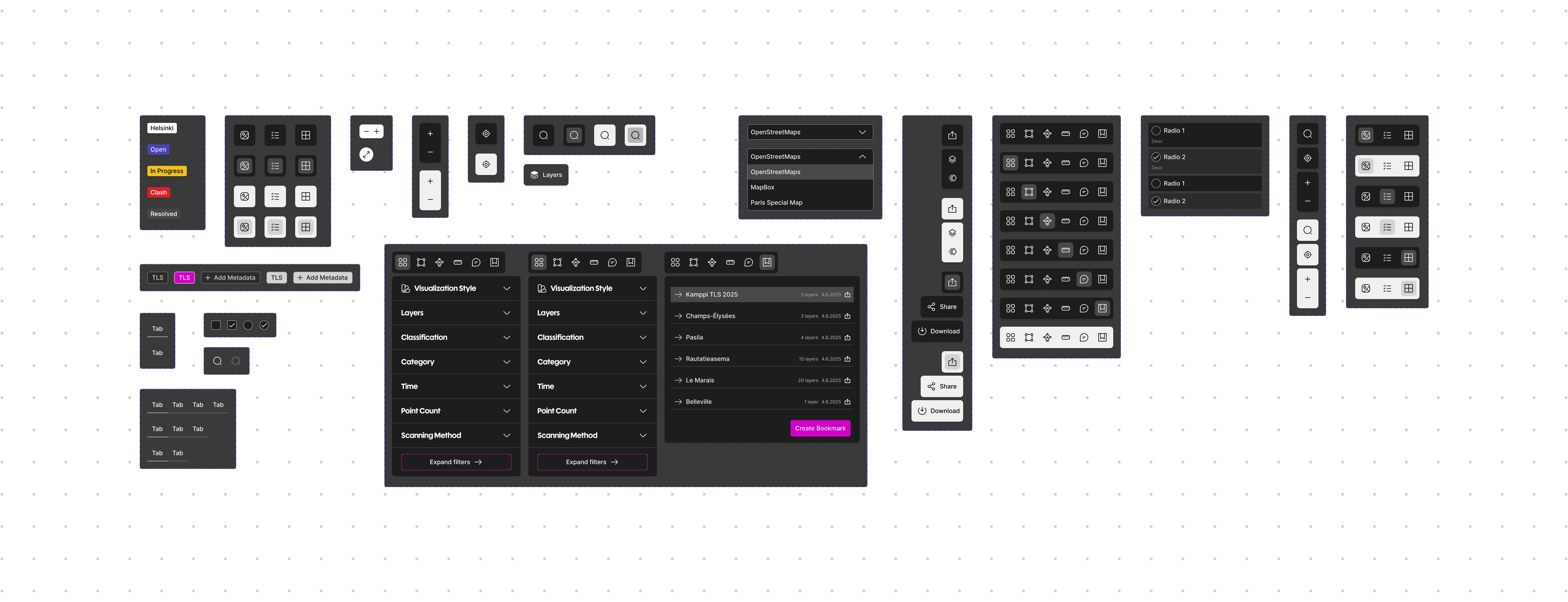
And because LumiDB needed to ship fast, we built a lightweight design system early. The result was a consistent UI foundation that supported implementation speed without compromising quality.
Snapshot of our design system components, built from the ground up for this 6 week project.
Result
LumiDB was able to implement the design efficiently and ship with clarity. The platform’s capability was validated at a national capital scale through deployment with the City of Helsinki. The deployment replaced legacy workflows relying on physical hard drive shipments with an API-driven streaming architecture, eliminating the security risks and delays of uncontrolled file duplication. Massive datasets that previously took 10 to 15 minutes to open in desktop software now load instantly in the browser, enabling non-specialists to utilize 3D data without expert assistance. We proved immediate integration by streaming heavy reality capture data directly into the City’s diverse software ecosystem, including QGIS, 6DPlanner, Kunta3D, and Virtual City Systems.
Following these results, multiple large international infrastructure operators are now evaluating LumiDB for production use. The product experience has moved beyond MVP stage into a mature, continuously evolving platform — fully usable for organisations of any size.
These logos mark LumiDB’s traction across the project timeline — early believers, active collaborators, and new customers after launch.
Video Demos
These video demos show how the product experience we designed is used in practice to navigate and manipulate gigabytes of real-world point cloud data from reality capture.
General Usage Demo (in English)
Here is Sampo - one of the founders of LumiDB - demoing the new interface and the point cloud manipulation functions of the LumiDB product.
User Interface Explained
How to Browse Massive 3D Material Sets
Cropping Data and File Boundaries
Camera Controls
Exporting Data Tiles to other 3D Software
In Their Own Words: Client Case Studies & Interviews
Explore how LumiDB is used in real-world workflows across cities and infrastructure. These client case studies and interviews highlight the impact of streaming point cloud data, practical integrations, and adoption beyond specialist teams.
These users have used the product experience designed in this project.
"It is a minimalist interface that leaves room for the data. It is simple enough for beginners but powerful enough to visualize complex point clouds instantly." — Jukka Alander, Technical Specialist. Read more.
"Reality-capture data gives a more reliable picture than manual measurements. We’re hearing from customers that reality-capture–based verification will replace many traditional measurements. You collect more data, faster, and you can prove compliance with far more certainty." — Visa Hokkanen, Chief Product Officer. Read more.
"This loads instantly, while other tools take 15 minutes just to open a file." — Suvi Uotila, Team Leader, GIS Center. Read more.
"It felt like an external engine built exactly for our problem, LOD and querying at scale." — Kim Toivonen, Senior Developer. Read more.